The problem
The Mohawk Valley has plenty going on — high-school games streamed online, community events, local news — but no single place to find any of it. The information lives on school athletic pages, venue calendars, Facebook posts, and shrinking newspaper sites. Everybody in a small region says the same thing: "somebody should put this all in one place." Nobody does, because aggregation is unglamorous work that never feels finished.
The insight
The reason these projects die isn't technical — it's scope. A "portal" that tries to be everything for everyone needs a staff. A front page — what's happening, what's streaming, what's news, today — needs a pipeline and an editor's eye. We scoped it as the second thing and refused the first. (This project is the origin of a rule we now apply to every engagement: find the smallest useful version.)
Constraints
Local platforms have brutal economics: the audience is real but small, so the running cost has to stay near zero and the maintenance burden near-nil. That ruled out anything requiring daily manual curation and pushed every design decision toward automation with light editorial control on top.
The build
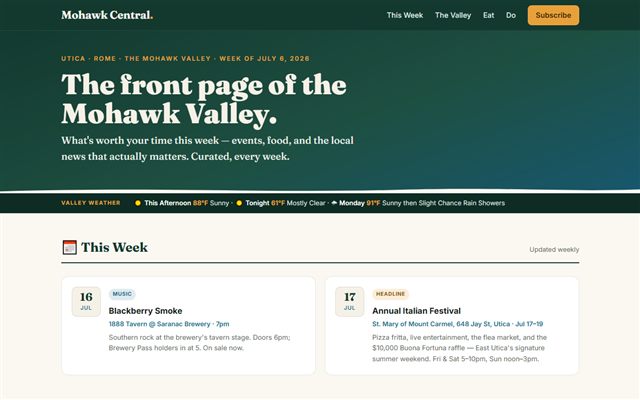
Under the hood, Mohawk Central is a set of aggregation pipelines — pulling events, livestream schedules, and news from their scattered sources, normalizing them, and laying them out on a page that loads fast on the aging phones and thin rural connections a local audience actually uses. The front end stays deliberately plain: a front page, in the newspaper sense, not a feed competing for dopamine.
The editorial layer matters as much as the plumbing. Aggregation without judgment produces noise; a human deciding what leads, what's local enough, and what's junk is what makes it a front page rather than a scraper.
Results
Live and growing. The site does its job every day with operating costs a hobbyist could sustain — which is exactly what makes a small-region platform survivable. It also serves as a working proof for a whole category of client conversation: the long-shelved "somebody should build this for our community / industry / niche" idea, scoped down to something that actually ships.
What we learned
Feeds rot. Sources change format, move, and vanish without notice, so the real engineering isn't the first version of a pipeline — it's building pipelines that fail loudly, degrade gracefully, and get fixed in minutes. Anyone quoting an aggregation project without a plan for source rot is quoting the demo, not the product.