Digital products, platforms, and systems.
Built with three decades of judgment.
Ivylane designs, builds, and operates software — custom tools, automations, customer portals, commerce, and the products you'll find below. Technologies change. Knowing what to build, what to skip, and what will still be standing in ten years is the part that compounds.
On the web since 1995 · Products we build, we also operate · This page loads in under a second — test it yourself
Products we designed, built — and still run.
The strongest proof a studio can offer isn't a portfolio thumbnail; it's software with real users that we operate ourselves, every day. Each project below is a full case study: the problem, the constraints, the architecture, and what we learned.
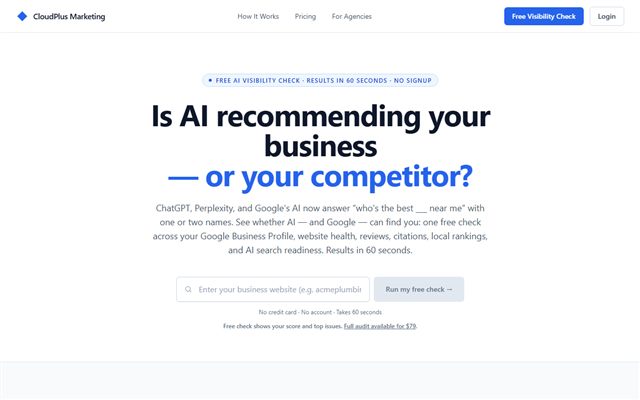
CloudPlus Marketing
Local businesses can't tell whether AI assistants recommend them. CloudPlus answers that with automated visibility audits — a crawling and scoring engine, PDF reporting, and payments, running as a real product today.
Read the case study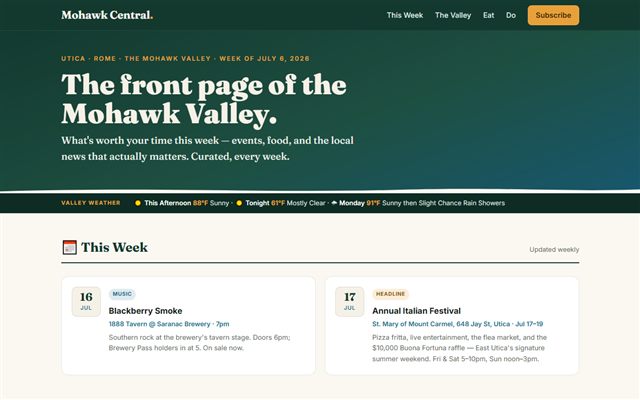
Mohawk Central
A region's events, school livestreams, and news, scattered across dozens of sites — pulled into one fast front page for the Mohawk Valley. The classic "directory idea," actually shipped.
Read the case study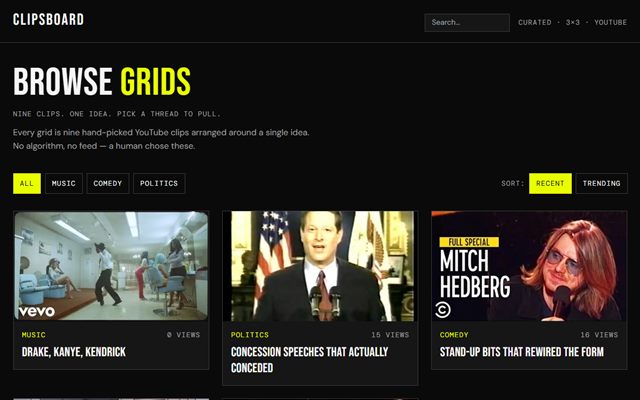
Clipsboard
A curated way to share YouTube: editorial 3×3 boards on a clean, fast front end. A small product taken from idea to something anyone can use — deliberately kept small.
Read the case study
Jtera
A Shopify storefront operated end to end — theme work, product data, integrations, and the unglamorous daily operations that decide whether a store actually makes money.
Read the case studyOrganized around problems, not services.
Nobody wakes up wanting "software development." They want a process to stop living in spreadsheets, an idea tested before it's expensive, a system modernized before it fails. We think, design, and build — the same hands, start to finish.
Product strategy
Working out what the thing should actually be — and finding the smallest version that's genuinely useful. Sometimes the honest answer is "don't build this." We say so.
Software engineering
Internal tools, customer portals, booking and intake systems, dashboards, and the integrations that make two systems finally talk to each other.
AI & automation
Practical AI: retrieval, extraction, assistants that know your business, and workflow automation — plus a clear-eyed view of when conventional software is the better tool.
Web platforms
Hand-coded sites and platforms that load in under a second, score well without tricks, and can be maintained by ordinary people. No page builders, no lock-in.
Data & modernization
The aging database, the fragile spreadsheet, the half-finished build another developer left behind — rebuilt on foundations that last, with your data intact and in your hands.
Search & AI visibility
Structure, schema, and speed so Google — and now ChatGPT and Perplexity — can find your business and recommend it correctly. Includes the flat-price $499 Fix Sprint.
Most projects don't arrive as a spec.
They arrive as a sentence.
“We've been doing this in spreadsheets for years.”
“I wish customers could just do this themselves.”
“I've had this idea for ten years.”
“Somebody retypes this every single week.”
“I got a quote years ago and shelved the whole thing.”
“I don't know if this is a website, an app, or what.”
Any of those is a complete brief. Part of the job — often the most valuable part — is working out what the thing should be, then finding the smallest version that's genuinely useful. We scope down before we scope up. Sometimes the answer is a two-day automation, not a six-month build. Sometimes it's an off-the-shelf product we'll point you to. We'll tell you either way — that advice is free.
And the economics have shifted: AI-assisted development has made the project you shelved because it cost too much probably affordable now. We wrote up exactly why, without the hype.
Technologies change.
Good judgment compounds.
Ivylane has been building on the web since 1995 — before Google, before broadband, before most of today's agencies existed. Eight technology eras later, the lesson isn't nostalgia. It's pattern recognition: which shifts matter, which are expensive noise, and what will still be standing when the cycle turns.
The early web
Hand-written HTML. Everything since is still, underneath, a document and a link.
Ecommerce
The first carts and payments. Trust and speed mattered more than features. Still true.
Search
Being findable became existential. Structure beat tricks then; it beats tricks now.
Mobile
The screen shrank; the sites that survived were the ones built simply.
Cloud & SaaS
Owning servers stopped making sense. Owning your data never did.
APIs
Software became plumbing between systems. Integration became the product.
Generative AI
Building got cheaper. Judgment didn't. That gap is where we work.
Describe the problem.
Plain English is perfect.
You don't need to know whether it's a website, an app, or an automation — working that out is part of the service. You'll get a real reply within one business day, from the person who'd build it: an honest take, and a written estimate if it's practical.
- A written estimate in plain English before any work starts
- You own the domain, hosting, data, and code from day one
- Direct line to the person doing the work — no handoffs
- An honest "don't build this" when that's the right answer
Prefer email or a call? richard@ivylane.com · (315) 927-1211
No spam, no sales calls. Just want a free website review? Say so in the message — how it works.