The problem
When someone asks ChatGPT or Perplexity for "a good plumber near Utica," some businesses get recommended and some don't exist as far as the AI is concerned. The owners can't tell which group they're in, and they certainly can't tell why. Agencies were happy to sell them a monthly retainer to find out; nobody offered a straight, automated answer.
The insight
AI assistants don't have secret knowledge — they read the same public web Google does, but they lean harder on structure: schema markup, consistent listings, legible pages, fast loads. That means visibility is checkable. If a person with expertise can audit a business by hand in an hour, software can audit it in minutes — and a score you can re-run beats an opinion you have to trust.
Constraints
Built and run by an independent studio, so the product had to operate itself: no sales calls, no manual fulfillment steps in the happy path, no infrastructure that needs babysitting. Every audit had to complete unattended and produce something a non-technical owner could read — which shaped almost every decision below.
The build
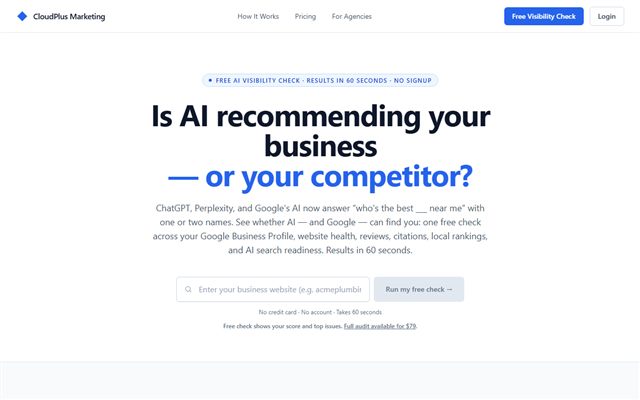
The heart of CloudPlus is a seven-part audit pipeline: fetch the business's web presence, parse it, run each check, score the results, and explain them. Around that engine sits a product — report generation as branded PDFs, Stripe for payment, and a front end that asks for nothing but a business name and web address.
Two design rules held throughout. First, every finding must be explainable in plain English — a score without a "here's what this means and what fixing it looks like" is just a number designed to scare people. Second, the audit must be re-runnable, so improvement is provable. Those two rules are also why the product funnels honestly: some businesses run an audit and find out they're fine. That result ships too.
Results
CloudPlus runs today as a real product with real customers — audits execute end to end without human intervention, reports render automatically, payments clear through Stripe. It also feeds back into Ivylane's client work: the same audit thinking powers the Fix Sprint, where the top findings get fixed rather than just reported.
What we learned
The hard part wasn't the crawler — it was the explanations. Translating "missing LocalBusiness schema" into a sentence a shop owner acts on took more iterations than any technical component. It confirmed something three decades of this work keeps teaching: the interface between software and human judgment is where products succeed or die, and it deserves the most design attention, not the least.